Navigating Mental Health at Work
Mental Health and Workplace Wellness
We are finding ourselves in a time where technology rules and we’re living the ‘always on’ lifestyle. “The term ‘work life merge’ is more appropriate to many of us rather than ‘work life balance” Re-energise Eat Sleep Move (CIPD 2016)
How did this happen, wasn’t technology supposed to support us in generating efficiencies so we could have more time for ‘us’? Instead, we find ourselves having to do more, be more, and be open and ready for change… constantly.
There is no doubt we are dealing with more pressures in our work and lives. Who is actually working a 9-5 job? Does everyone always take their full annual leave or advantage of the unlimited paid time off (pto)? Who’s been getting to the office early or working late? Taking the time to cook and eat a balanced meal or are you grabbing something on the go? Do you more often than not sleep soundly for eight hours a night? Motivated to hit the gym or ensuring you’re taking time for you (mental well-being)?
When we’re not in balance and prioritising that balance, there is no doubt our current lifestyles can be stressful.
The Concerns, Impact & Costs
Mercer commissioned a survey of ~1500 employees across the UK and Ireland in 2015 to uncover how pressures were affecting people’s lives and 98% of those surveyed acknowledged they had concerns. CIPD shared some of the findings (member link) noting the biggest worry (concerned or very concerned) for Irish-based respondents were:
Maintaining a healthy lifestyle while holding down a job (59%)
Providing for family in case of illness or death (55%) and
Paying household bills (54%)
The results showcased that these personal worries & concerns were having a significant effect on their well-being. Of the 98% that shared concerns: 82% reported increased personal stress, 58% said they had less motivation, 58% felt they had less energy, 52% believed stress was having some impact on their overall health.
This also impacted their work performance where 64% reported reduced concentration in the workplace, 59% felt reduced job satisfaction and 44% noted reduced productivity.
Professor Sir Cary Cooper, a leading expert in occupational psychology from Manchester Business School, in an interview with CIPD reports how presenteeism has an impact on workplace productivity (CIPD member link).
‘You’re present but you’re not delivering. And really what we need are healthy people, engaged, wanting to work. Working hard, but not necessarily long, because we don’t need long.’ He added, ‘We know from research if you consistently work long hours you will get ill…and we’re turning up early, we’re staying late, we’re sending emails from home at night…and we’re not recovering from the pace, the load, and the insecurity of work.’
Impact on performance due to presenteeism can include; taking longer to do tasks, having difficulty making decisions, difficulty multi-tasking, reduced patience, task avoidance, and lack of concentration.
In CIPD’s most recent report; in conjunction with Mind, The People Managers guide to Mental Health, Sept 2018 (member link), outlined that the scale and impact of poor mental health at work is increasing in the UK.
Key takeaways:
Poor mental health was the most common cause of long-term sickness absence
Stress-related absence had increased in nearly two-fifths of organisations (CIPD 2018)
A Mind survey found that one in ten employees rated their current mental health as poor or very poor
26% said this was due to problems at work and a further half said it was due to a combination of problems at work and outside of work
40% said they had taken time off as a result
49% of employees felt their employer supports their mental health
Disclosure is seen as the biggest barrier, creating a ‘vicious circle’ for both employees and employers.
43% of employees would not feel comfortable disclosing unmanageable stress or poor mental health to their employer or manager (CIPD 2016)
Research has shown that men tend to have less knowledge about mental health and are also less likely to report their own experiences of mental health problems, as well as less likely to discuss mental health problems with a professional (Time to Change 2017).
Management style is the second main cause of work-related stress, showing that how managers go about their role has a direct impact on people’s mental well-being (CIPD 2018).
The cost to an employer can be significant when faced with absenteeism, presenteeism, and turnover due to mental health.
“In Ireland, absenteeism is costing us €1.7 billion per annum whilst the cost of presenteeism has not been quantified. According to Paul Hemp of the Harvard Business Review, presenteeism can be costlier than absenteeism and cut productivity by up to 33%.” Re-energise Eat Sleep Move (CIPD 2016)
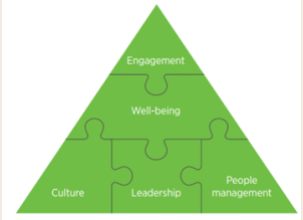
Studies and research into the areas of workplace well-being and mental health has led to a multitude of evidence showcasing that mindfulness and well-being in the workplace has a positive effect on employee engagement.
People Management Skills are Key
HR policies and procedures are vital as a given. Ensuring zero tolerance on bullying (to support conflict avoidance) and fostering a culture and environment of tolerance and support also needs to be embodied by leadership.
Companies can also invest in various corporate benefits including EAP (employee assistance programmes) but with the increase in start-ups and smaller enterprises not all businesses can afford these.
But it is communication and strong people management skills that are repeatedly referenced in my readings, with the line managers’ role central to workplace well-being and employee engagement.
People in these positions that are mindful (“paying attention in a particular way: on purpose, in the present moment, and non-judgmentally.” Jon Kabat-Zinn) who part-take in regular 1-1’s with their teams, who have fostered a relationship of trust and inquire about work and life are in a much stronger position to assess early signs of behavioural changes and can instigate open and honest conversations to address concerns.
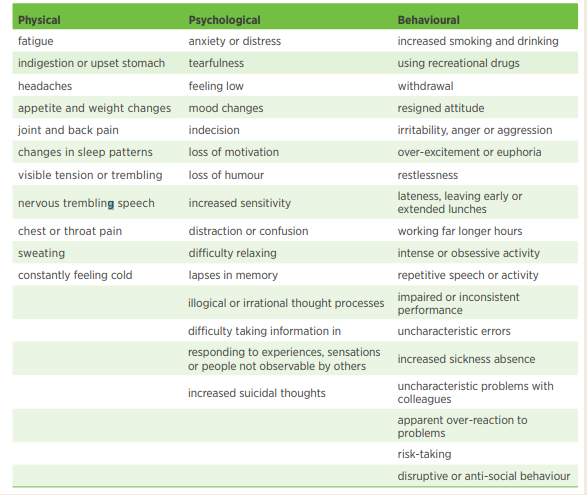
The People Managers guide to Mental Health, CIPD, 2018
Upon identification they can encourage, when needed, those to seek professional help via their GP or EAP programme; and/or consider what reasonable flexibility or adjustments can be made:
Flexible working hours, work space or break times
Seating with natural light
Time-off for mental health related appointments
Revision of duties, reallocation of tasks
Create opportunities for coaching or mentoring, learning and development
Access to appropriate support groups or networks
Advocating good mental health within the workplace encouraging uptake in activities that support resilience: exercise, meditation, healthy eating, mindfulness etc
Fostering a positive and encouraging environment – acknowledge key contributions and positive achievements, encourage collaborations and information sharing & involve employees in decision making.
Be available
Adapted from: The People Managers guide to Mental Health, CIPD, 2018
Common Sense
Employees are also responsible for looking after their own well-being and health. Corporate initiatives can only go so far and require employee buy-in, so if spending, ensure you get feedback!
For me, fostering well-being in the workplace comes down to emotional intelligence and genuine consideration for those around us.
‘What made a huge difference was being asked if I was okay – simple as that. I don’t seek out people to tell…” The People Managers guide to Mental Health, CIPD, 2018
Be aware that mental health affects people differently and everyone’s experience and coping mechanisms can be entirely different even when suffering similar symptoms.
Be patient, open to listening and aware we all suffer with mental health. We need to remove the stigma and foster a supportive culture treating people with respect.
When attending a HR Directors dinner last year for Mental Health Day, a question was posed at the start of the evening. What is one thing you can do and start immediately? Rather than being faced with a mammoth task of action planning for corporate initiatives, it spurred conversation around, what we could do tomorrow.
This has stuck with me and I challenge you to come up with one simple and small thing that you can implement today.
For me I ensure my team know I’m available to go for a cup of tea and chat anytime, I’m non-judgmental and it’s ok to talk to me. I’m there to support them and I ensure I acknowledge their achievements and contributions fostering a positive environment.
Sometimes it’s the little things that count!
Elizabeth Lenihan is an award-winning Career Strategist and Talent Consultant with nearly 20 years of experience helping professionals across Ireland, the UK, the US, and Canada navigate interviews, career transitions, and professional growth. She is the author of The Ultimate Interview Guide, The Resume Writing Guide, The Performance Review Playbook, and Navigating Your Career with the MAPS Compass — available at elizabethlenihan.com/store and on Amazon. For 1-1 career coaching, contact hello@elizabethlenihan.com.
